NeuroDiverCity
  • HOME
    • About
  • RESOURCE @ YOUR FINGERTIPS
    • NEURO-INFOMATION >
      • MEDICAL MODELS OF DISABILITY >
        • MEDICAL MODEL VS SOCIAL MODEL
        • AUTISM >
          • AUTISM 1
          • AUTISM II
          • AUTISTIC REPRESENTATION IN FILMS
          • Childhood Disintegrative Disorder
        • RETT SYNDROME
        • ADHD >
          • ADHD I
          • ADHD II
        • ANGELMAN SYNDROME
      • UNDERSTANDING NEUROLOGY >
        • Neurology & Learning >
          • Co-Ocurring Challenges in learning
          • Visual Processing
          • Auditory Processing
        • SPECIFIC LEARNING DIFFICULTIES >
          • WHAT IS LD?
          • LD - READING >
            • HOW DOES IT AFFECT READING
            • DYSLEXIA - under revamp
            • Language Programs
          • LD - MATH >
            • HOW DOES IT AFFECT MATH
            • IDEAS FOR Nursery to Primary
          • STRATEGIES THAT SUPPORT LEARNING
        • MOTOR SKILLS & DEVELOPMENT >
          • All About Motor Development
        • SENSORY >
          • ALL ABOUT SPD - The 8 SENSES
          • ALL ABOUT SPD II
        • SOCIAL DEVELOPMENTAL SKILLS >
          • RDI - SOCIAL, COMMUNICATION & INTERACTION
          • Communication
        • Co-Occuring Challenges >
          • SELECTIVE MUTISM
          • EYE CONTACT
          • Toileting
        • OTHER UNIQUE ABILITIES / CHALLENGES
        • COPING STRATEGIES >
          • Anxiety Management
      • FOR PARENTS >
        • Preparing for Diagnosis Or Assessments - under revamp
        • PARENTING RESOURCES
      • HEAR FROM US - @SBSK
    • LEARNING RESOURCES >
      • LEARNING RESOURCES-PAGE >
        • LR - EARLY LEARNING YEARS
        • LR - SCIENCE >
          • SCIENCE PRIMARY
          • LR- SCIENCE SEC 1
          • LR- SCIENCE SEC 2
          • LR - SCIENCE SEC 3
        • LR - HISTORY >
          • LR - HISTORY SEC 1
          • LR HISTORY SEC 2
          • LR HISTORY SEC 3
        • LR - GEOGRAPHY >
          • GEO SEC 1
          • GEO SEC 2
          • GEO SEC 3
        • LR - MATH
        • LR - GENERAL KNOWLEDGE >
          • GENERAL KNOWLEDGE
          • WORLD
        • Music Appreciation
      • Sexuality Resource
      • WOMEN & HORMONES
    • INCLUSIVE LIVING >
      • INCLUSION IN EDUCATION
      • Inclusive Technology
    • SUPPORT SERVICES & CENTRES >
      • THERAPY & ASSESSMENT SERVICES
      • EDUCATION FOR EDUCATORS / CAREGIVERS / PROFESSIONALS
      • EDUCATIONAL SUPPORT - YOUNG
      • HIGHER EDUCATIONAL / LIFESTYLE / COMMUNITY SUPPORT
      • EMPLOYMENT SUPPORT & PROGRAMMES
      • ADAPTIVE LIVING RESOURCES
    • FINANCIAL SUPPORT & PROTECTION
    • OTHER ORGANIZATIONS SUPPORT & SERVICES >
      • Quotes and Pictures
    • OVERSEAS SUPPORT & ORGANIZATIONS
  • SUPPORT US!
    • SUPPORT GROUPS IN SINGAPORE
    • SOCIAL ENTERPRISES
    • SURVEYS/ RESEARCH/ SCOUTING SUPPORT
    • FUNDRAISE!
    • Experience Sharing Blog
  • INCLUSIVE SERVICES & ACTIVITIES
    • INCLUSIVE ACTIVITIES/ SPORTS/ PLACES
    • REGULAR EVENTS & ACTIVITIES
    • UPCOMING EVENTS
    • MAPS FOR ALL PLACES
    • Resources from Latest Talks/ Forums
  • Contact
  • HOME
    • About
  • RESOURCE @ YOUR FINGERTIPS
    • NEURO-INFOMATION >
      • MEDICAL MODELS OF DISABILITY >
        • MEDICAL MODEL VS SOCIAL MODEL
        • AUTISM >
          • AUTISM 1
          • AUTISM II
          • AUTISTIC REPRESENTATION IN FILMS
          • Childhood Disintegrative Disorder
        • RETT SYNDROME
        • ADHD >
          • ADHD I
          • ADHD II
        • ANGELMAN SYNDROME
      • UNDERSTANDING NEUROLOGY >
        • Neurology & Learning >
          • Co-Ocurring Challenges in learning
          • Visual Processing
          • Auditory Processing
        • SPECIFIC LEARNING DIFFICULTIES >
          • WHAT IS LD?
          • LD - READING >
            • HOW DOES IT AFFECT READING
            • DYSLEXIA - under revamp
            • Language Programs
          • LD - MATH >
            • HOW DOES IT AFFECT MATH
            • IDEAS FOR Nursery to Primary
          • STRATEGIES THAT SUPPORT LEARNING
        • MOTOR SKILLS & DEVELOPMENT >
          • All About Motor Development
        • SENSORY >
          • ALL ABOUT SPD - The 8 SENSES
          • ALL ABOUT SPD II
        • SOCIAL DEVELOPMENTAL SKILLS >
          • RDI - SOCIAL, COMMUNICATION & INTERACTION
          • Communication
        • Co-Occuring Challenges >
          • SELECTIVE MUTISM
          • EYE CONTACT
          • Toileting
        • OTHER UNIQUE ABILITIES / CHALLENGES
        • COPING STRATEGIES >
          • Anxiety Management
      • FOR PARENTS >
        • Preparing for Diagnosis Or Assessments - under revamp
        • PARENTING RESOURCES
      • HEAR FROM US - @SBSK
    • LEARNING RESOURCES >
      • LEARNING RESOURCES-PAGE >
        • LR - EARLY LEARNING YEARS
        • LR - SCIENCE >
          • SCIENCE PRIMARY
          • LR- SCIENCE SEC 1
          • LR- SCIENCE SEC 2
          • LR - SCIENCE SEC 3
        • LR - HISTORY >
          • LR - HISTORY SEC 1
          • LR HISTORY SEC 2
          • LR HISTORY SEC 3
        • LR - GEOGRAPHY >
          • GEO SEC 1
          • GEO SEC 2
          • GEO SEC 3
        • LR - MATH
        • LR - GENERAL KNOWLEDGE >
          • GENERAL KNOWLEDGE
          • WORLD
        • Music Appreciation
      • Sexuality Resource
      • WOMEN & HORMONES
    • INCLUSIVE LIVING >
      • INCLUSION IN EDUCATION
      • Inclusive Technology
    • SUPPORT SERVICES & CENTRES >
      • THERAPY & ASSESSMENT SERVICES
      • EDUCATION FOR EDUCATORS / CAREGIVERS / PROFESSIONALS
      • EDUCATIONAL SUPPORT - YOUNG
      • HIGHER EDUCATIONAL / LIFESTYLE / COMMUNITY SUPPORT
      • EMPLOYMENT SUPPORT & PROGRAMMES
      • ADAPTIVE LIVING RESOURCES
    • FINANCIAL SUPPORT & PROTECTION
    • OTHER ORGANIZATIONS SUPPORT & SERVICES >
      • Quotes and Pictures
    • OVERSEAS SUPPORT & ORGANIZATIONS
  • SUPPORT US!
    • SUPPORT GROUPS IN SINGAPORE
    • SOCIAL ENTERPRISES
    • SURVEYS/ RESEARCH/ SCOUTING SUPPORT
    • FUNDRAISE!
    • Experience Sharing Blog
  • INCLUSIVE SERVICES & ACTIVITIES
    • INCLUSIVE ACTIVITIES/ SPORTS/ PLACES
    • REGULAR EVENTS & ACTIVITIES
    • UPCOMING EVENTS
    • MAPS FOR ALL PLACES
    • Resources from Latest Talks/ Forums
  • Contact

AUTISM
(Identity first language will be used throughout the website)

"Put aside what you can’t do, and focus on what you can do, And every single student has that right. We got to flip that deficit model. And not only do we have to flip that deficit model rhetorically by talking about what’s right with kids, we have to flip that deficit model with where we spend our time." -  Jonathan Mooney 

ASD
(Autism Spectrum Disorder)
Medical Model Name

(*Please note Autism Spectrum Disorder now is a single category in DSM-V that encompasses, Autistic Disorder, Asperger’s Disorder, Childhood Disintegrative Disorder and PDD-NOS). 

Many people on the spectrum, do not use the word disorder as it carries prejudiced stigma in society. It is best to enquire whether they preferred to be called by identity first language or person first language, whatever that is most comfortable for them. 

Identity-First Language VS Person-First Language


​In the following pages, the medical model will guide base on research for understanding what are some of the neurological differences, whilst the social model will guide you on the approaches and paradigm shift to how we get to understand and provide support.


Many traits in the medical model can vary from individual to individual. In the website the various conditions will be separated into different pages. In reality some traits overlap with each other and can co-exist.
NCLD presentation about ASD
​(Medical Model)

​Medical Model of the 
​
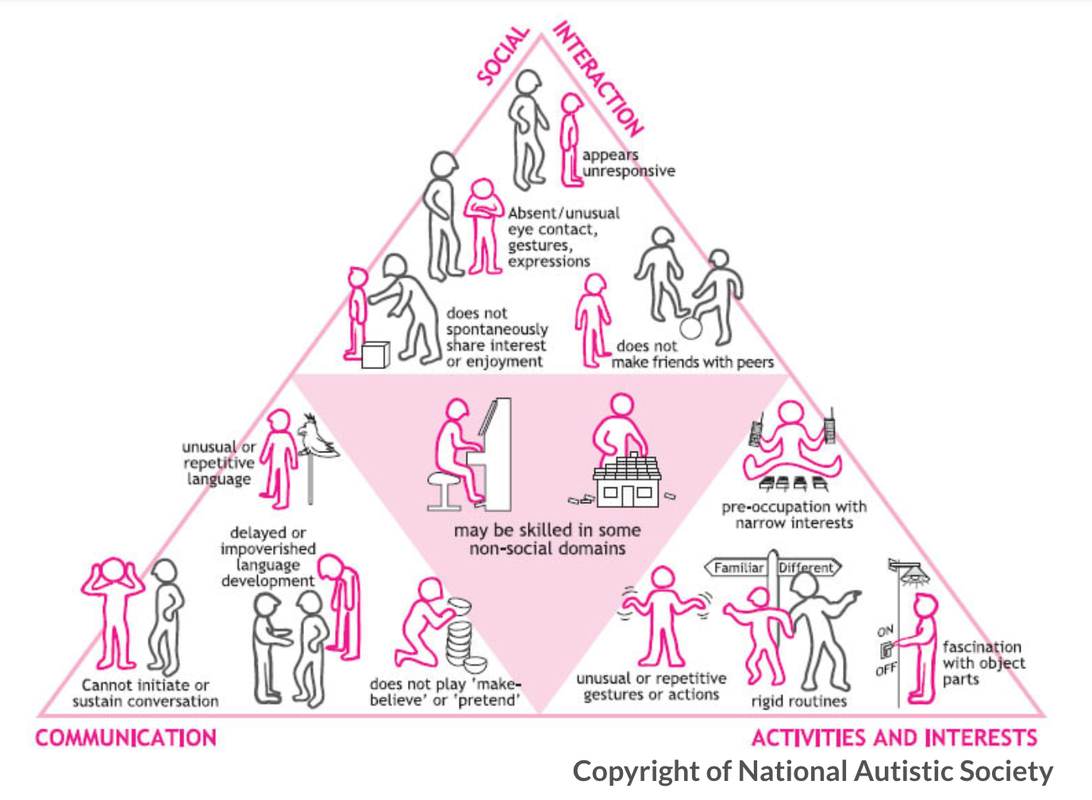
3 main areas of challenge 

Picture
The "Triad of impairment" involve challenges with
​
  • SOCIAL INTERACTION
  • COMMUNICATION
  • RIGID & REPETITIVE ACTIVITIES & INTERESTS​
The diagram shows a few examples that might be misleading; for eg. unusual repetitive language. If you read the pages about 'Communication', you will realize that this could be how the individual is trying to communicate or express him/herself. 

Another example is "does not play 'make believe' or 'pretend', the individual might be playing in their own way that they prefer and might not be something a typical might think of. ​Playing 'out of the box', 'seeing the wonders of life', or spinning an item due to sensory needs can sometimes be misunderstood.

Pre-occupation with narrow-interests are what geniuses and great skillsets can stem from. Because of their keen and detailed observations, these interests can become a really useful skill for learning and some even future careers.

Many think eye contact is a problem, but if you look at the page on eye contact you will realize that most of us do not fully just use our eyes to engage another person, I don't think anyone who finds looking at something painful feels comfortable to speak if they are forced to deal with the pain.

Whatever is the case, you will realize medical models focuses only on what they cannot do. Majority of autistics have stepped out to help practitioners, parents to understand alot of these perspectives that might not be true.

The medical model can support to an extent to understand hidden learning difficulties, strategies for support through guiding in a step by step manner, to understanding neurology. 


​PROCESS OF IDENTIFICATION

Often, parents might get fearful of screenings and diagnosis. Do note that assessment results may vary and it does not equate to true cognitive ability. Because many of the learners might have challenges to even express what they might be thinking of or have other co-morbid challenges that might impact on them at that period in time. Especially for non-verbal children, most of the time people discriminate them immediately, thinking that they have cognitive disability.
​
Assessments can however be useful to give a basic outline of which milestones your child might be at, this gives more information for educators and professionals to better understand how to support your child. But remember professionals, to try to do strength based assessments as well, it provides a more balanced view and focuses on empowering while supporting the child. Strength-based writing can be found at "Neurology & Learning Page".

Some early signs to help parents

A FUN, ENGAGING WEBSITE TO LEARN ABOUT AUTISM BY AN AUTISTIC!
THERE IS EVEN A KIDS VERSION​


ASPERGER'S
​is now part of the Autism Spectrum umbrella since DSM-5.

NAS - WHAT IS ASPERGERS (medical model)
AANE - List of resources
Picture

SOME SIGNS THAT GOES
​UN-NOTICED

1. Autism spectrum disorder and early development signs

2. Signs of autism spectrum disorder in older children and teenagers
​


As every child is unique in both strengths and challenges, different assessments are needed for specific evaluations of skillsets by different therapists.
The main diagnosis must be carried out by a psychologist. 
​Individualised Educational Plans (IEP) can be supported by an educational psychologist to help parents plan on the goals for supporting the child throughout the year.

​
The Diagnostic and Statistical Manual of Mental Disorders (DSM-5) is the handbook used by health care professionals as an authoritative volume containing and categorising descriptions, symptoms, and other criteria for diagnosis. It is where all the labels are categorized.

​
UNDERSTAND SCREENINGS & DIAGNOSIS
INDEPTH LIST OF DIAGNOSTIC
​& ASSESSMENT TOOLS

National Autistic Society (NAS) website shows how to navigate through the initial diagnosis for parents and what kind of challenges some autistics might face.


​

​


Indepth look into DIAGNOSTIC CRITERIAS


​1. DSM-5 criteria for ASD diagnosis

2. DSM-5 OVERVIEW CHECKLIST


​


​Some things you can do to prepare your child in the process of diagnosis and assessment.

​

1. Have the assessment conducted in a few sessions, allowing the child to first bond with the psychologist. So that it is not rushed, and the child is able to do better as the entire assessment duration can be quite long and rigorous. Something that takes time for development of the child to cope with. 

​2. Familiarising the child with the setting and person, helps to reduce anxiety and uncertainty.

3. If child has language and can understand and follow instructions, you can provide a number of broken down steps, of what is expected.

4. You can also bring things of interest eg. plushies to let the psychologist use to work with the assessment.

5. For children with high anxiety, you can request to sit in and accompany the child, but only for emotional support.

6. For children with co-morbidies eg. selective mutism, you can request to allow child to write instead of speak. However this can affect the assessment as some parts of it includes speech. 

7. Don't try to cheat the exam. The assessment should clarify on the child's needs, so that educators and other professionals know where to support the child in. They might miss the needs if the results are not accurate. We understand parents might be concerned due to the cognitive testing portion, as it can affect the school they will go to. Sometimes parents can defer their child for a year while building up on their gaps and needs as well as confidence and relatability to social interactions. 

8. Let child know how well he put effort to withstand the session. Don't focus on the results. Its more empowering to focus only what the child has done really well. That way it paves for confidence to handle other types of test situations in future.

​Having assessments for ASD or any other learning difficulty early is useful for any early intervention to be carried out for your child.

​The earlier the child receives support, the earlier they will be able to cope with situations that require learning.


Disclosure of child's diagnosis to a mainstream school setting.

In mainstream public schools, many times parents are not ready to disclose their child's diagnosis or even have their child diagnosed. They worry that it can affect their future. However we would like to encourage parents to have consultations with professionals, as many of them can have many hidden challenges that needs alot of understanding and support. If these hidden challenges were thought to be pathological, the impact would be hard on the child for sure. Child might face discrimination from peers, educators, and might not receive the kind of support he/she really needs in order to learn. Some schools without any reports or assessments would not be able to cater any support for your child. As well as any accomodations for school learning, and exam situations. 

Every mainstream there will be a couple of teachers as the role of Allied Educators (Learning and Behavioural Support), School Counsellor who might be assigned to support your child. However there is a limit to the number of these teachers in one school. As there might be several students in each level to have unique needs, they might only have more support for those with higher needs. As such it is best to closely work with the AEDs, to discuss about your child's needs when applying to the school. Some parents might require the AEDs and teachers to be tactful especially with forms with their information, to not to disclose the child's diagnosis to the child, to allow the child to slowly have more time and growth before any disclosure was made. It is best to discuss with school leaders, and supporting teachers and AEDs on the needs of your child.

Usually I would encourage parents to write a summary of child's profile, remember a strength-based profile can greatly change how certain support can be for your child. The summary can be for eg. child's interests, strengths, challenges, what strategies can work, any trauma or fears, list of formally diagnosed and suspected conditions, parent's main focus and expectations for child in the school. Any information that can help the educator understand your child better.

​


Disclosure of child's diagnosis to the child.

Remember, the process can harness the social model to be in focus. To fully embrace, showcase diversity of all kinds of humans, all kinds of brains, all kinds of race, religion, cultures, disabilities. Strengths & weaknesses of different people, if child do know any famous people eg. albert einstein, yes you can use that as well.
​
Getting Started: Introducing Your Child to His or Her Diagnosis of Autism
 - 
Marci Wheeler, M.S.W.

It’s Not a Secret: Why Disclosure is Important
​- 
By Lynne Mitchell, MSW
​
When (and How) Should You Tell Kids
​
A very good and clear guide for parents on timing and how to explain the diagnosis!
- Shuli Sandler, PsyD, and Michael Rosenthal, PhD

​

​SEE ME.
NOT THE LABEL.

BUSTIN' MYTHS

There are many stigmas in society that has many pre-conceived prejudiced notions of what autism is about and mostly from the deficit viewpoint.
Go To This webpage for some of the
top most misunderstood myths. 

From Awareness to Understanding to Acceptance and Appreciation
​
- ASAN


​Autistic Advocacy

Meet Rosie
My Autism and Me LICENCE - all rights reserved by BBC, CBBC Programmes
Meet Amythest Schaber:
​Self-Advocacy in a Culture of Cure (part one)
Amythest Schaber: NeuroWonderful Channel
Meet Carly Fleischmann, she face challenges with oral-motor apraxia and cognitive delay as a child. Through years of persistent therapy and hard work, Carly learned to spell and her voice eventually found its way out. Today she types with one finger, and shares the truths of autism. 
Speechless with Carly Fleischmann Channel
  • CHRIS PACKHAM ASPERGER'S AND ME PART1
  • CHRIS PACKHAM ASPERGER'S AND ME PART2
  • CHRIS PACKHAM ASPERGER'S AND ME PART3
  • CHRIS PACKHAM University Life with Autism Part 1

HISTORY OF AUTISM
​
A view into the early stages of awareness, situational challenges, diagnostic research,
​how parent-traps can cost and the positive and negative effects of social media.

​

​

1. PROJECT AUTISM - BRIEF HISTORY OF AUTISM

2. NeuroTribes: The Legacy of Autism and the Future of Neurodiversity

This book chronicles the entire history of autism research. A very essential read.

 - TED TALK (Steve Silberman points to “a perfect storm of autism awareness”)
​
3. DSM History
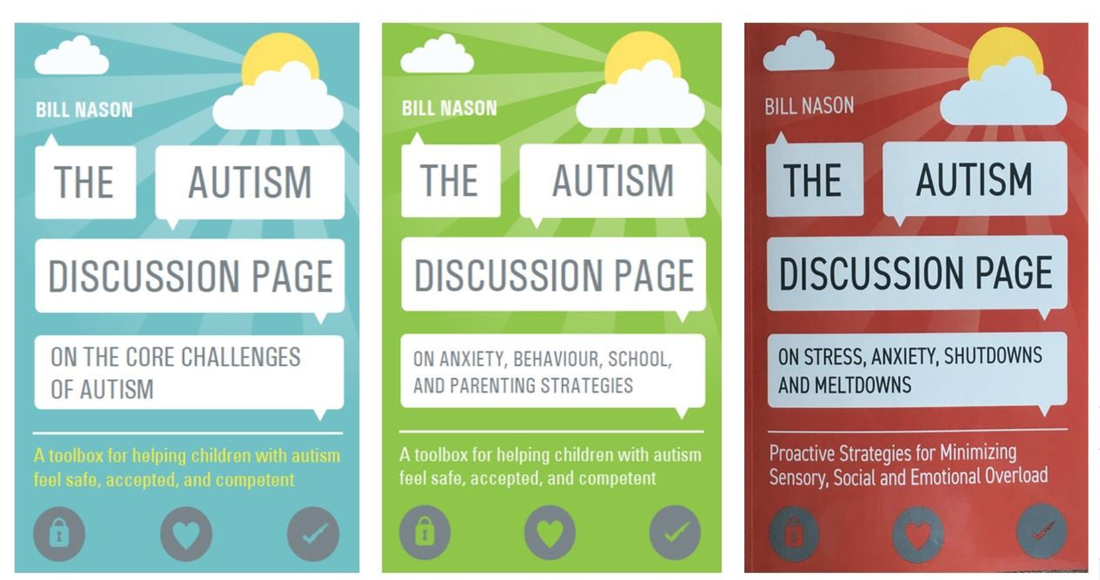
Bill Nason is a mental health professional with a masters degree in clinical psychology and more than 30 years of experience in treating individuals with developmental disabilities. Specializing in autism spectrum disorder and individuals with severe, multiple behavior challenges.

The Autism Discussion Page is devoted to providing a tool box of strategies for helping children on the spectrum feel “safe, accepted, and competent.” It is focused on parenting, teaching, and therapeutic strategies meant to improve the lives of children on the spectrum. 

He will present the presentations in a series of power points represented in photo albums:

Helping Your Child Feel “safe”

Satisfy Physical Needs Page
Tool 1 Meet nutritional needs
Tool 2 Treat medical/psychiatric needs
Tool 3 Reducing sensory overload
Tool 4 Calming meltdowns
Tool 5 Sensory diet
Tool 6 Physical activity

Reduce Confusion
Tool 7 Structured Daily Routines
Tool 8 Visual strategies
Tool 9 Slow it down, break it down
Tool 10 Clarify, verify, preview and review
Tool 11 Clear Boundaries & expectations

Respect Comfort Zones
Tool 12 Define and respect comfort zones

Helping Your Child Feel “Accepted”

Communicating Love and Acceptance
Tool #13 Understanding, acceptance
Tool #14 I love you rituals

Teaching Emotional Relating
Tool #15 Emotion sharing
Tool #16 Reciprocal interaction
Tool #17 Celebrating
Tool #18 Soothing

Teaching Nonverbal Communication
Tool #19 Facial referencing and nonverbal
Language
Declarative Language
Tool #20 Increasing acceptance with
declarative language

Acceptance at School
Tool #21 Advocate and collaboration
Tool#22 Peer mentoring

Helping Your Child Feel “Competent”

Learning Through Others Page
Tool #23 Don’t do for, do with
Tool #24 Apprentice Learning
Tool #25 We-Do Activities

Effective Training Tools
Tool #26 Basic Principles
Tool #27 Framing
Tool #28 Guided Participation
Tool #29 Stretching & Fading
Tool #30 Instilling Motivation

Teaching Apprentice Skills
Tool #31 Social Referencing
Tool #32 Co-regulation
Tool #33 Coordinating Roles
Teaching Emotional Regulation
Tool #34 Emotional Regulation
Tool #35 Stretching Comfort Zones
Tool #36 Tackling Fears

Increase Flexible Thinking Skills
Tool #37 Flexible Thinking
Tool #38 Dynamic Thinking
Tool #39 Problem Solving
Tool #40 Memory Books

Competence Over The Years
Tool #41 Building on Strengths
Tool #42 Start Early, Think Ahead
Tool #43 Transition Planning
Tool #44 Self Empowerment
Tool #45 Adult Supports

Autism Discussion FACEBOOK Page

Picture
There are 3 books from the author that are highly recommended for all parents. He has dedicated his lifetime of knowledge on the website and his books. 
CLICK TO KNOW MORE ABOUT THE BOOKS
GO TO FACEBOOK PAGE
Please DO NOT print out for DISTRIBUTION/ SALE or infringe copyrights. These are only used to share knowledge purposes. ​

This resource site includes inclusive services for all types of professionals. The reviews are from parents who shared their positive experiences with them. Do note that every individual is unique, and not every service provider is one size fits all. Negative feedback will not be displayed but do contact us if you feel that there are concerns, and we will decide to review for removal on a case-by-case basis. If you have come across any inclusive services that could benefit another family do contact us to place their services for other parents to find. Thank you people :D

​
Facebook Advocacy: 
(Updated events and sharings will be also available at 
​
www.facebook.com/ANeurodiversityRoadOfLoveSg/

Home

About

Contact

Copyright © 2017 NEURODIVERSE INCLUSIVE CENTRAL E-NETWORK .  ALL RIGHTS RESERVED
Photo from hannes-flo